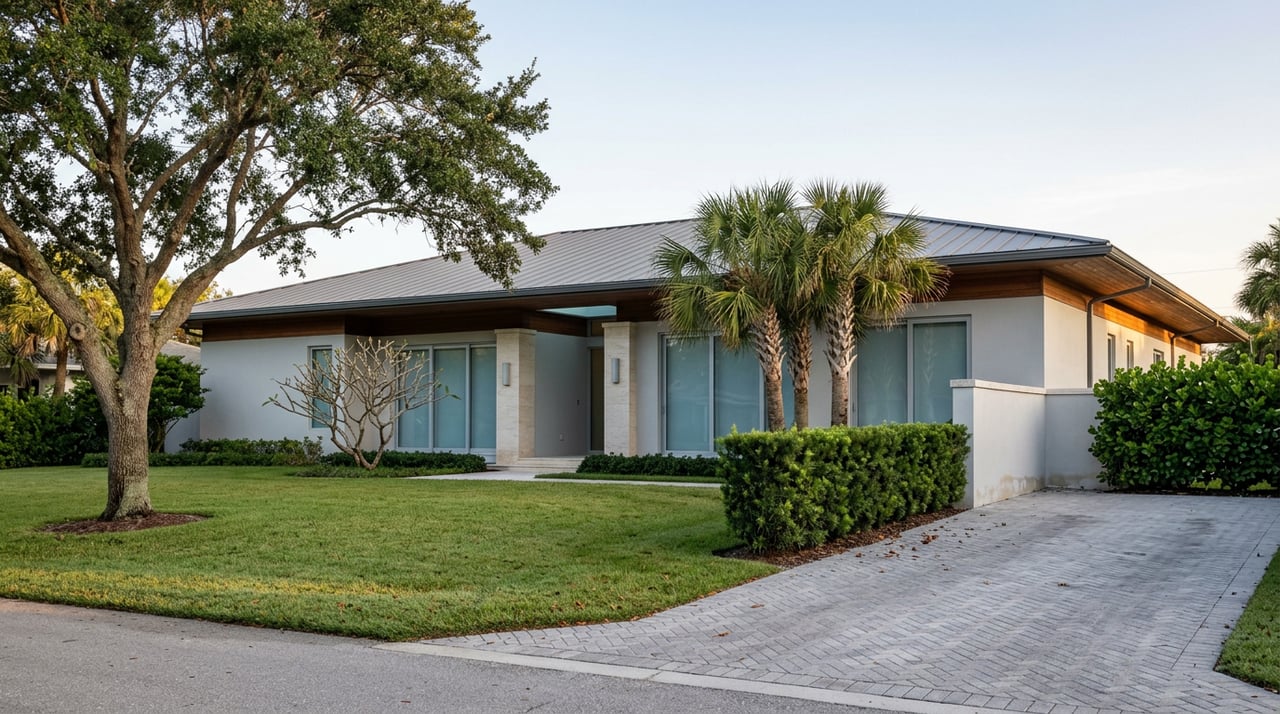
Casey Key Homes Sit For 170 Days. The Reason Isn't The Price Tag.
September 24, 2026
September 24, 2026
A Casey Key listing that sits on the market for months looks, from the portal, like a pricing mistake. It isn't. In the twelve months ending August 2, 2026, the median Casey Key home took 170 days to sell and closed at 83.6 percent of its original asking price. On most barrier islands, that combination reads as a seller who wouldn't budge. On Casey Key, it reads as a buyer and seller doing math on two different things.
That's the friction worth understanding before you write an offer here: the number on the sign rarely describes the house. It describes the lot, and whether the buyer on the other end of the negotiation has figured that out yet determines how long the listing sits.
Casey Key's median sold price for the twelve months ending August 2026 sits at $3,250,000. Measured against the island's 2024 peak of $5,600,000, that's a 42 percent pullback. Read as a headline, it sounds like the kind of correction that should worry anyone holding property here.
Read against the transaction volume, it tells a different story. Casey Key closes somewhere between 3 and 21 sales in a typical year, averaging just over 10. A market that thin doesn't need demand to soften for the median to swing hard. It needs the mix of what actually closed to shift, and on an island where teardown cottages and finished estates share the same zip code, that mix shift can move the median by seven figures without a single seller accepting less than they wanted.
Here's what else moved in the same window: the share of listings pulled from the market without selling dropped to 45 percent in 2026, well below the island's historical average of 67 percent. Fewer withdrawals alongside a lower median isn't a market in retreat. It's a market where more sellers are pricing to what's actually transacting instead of pulling the listing and waiting for a buyer who isn't coming.
| Measure | Figure | Window |
|---|---|---|
| Median sold price | $3,250,000 | 12 months ending Aug 2, 2026 |
| 2024 peak median | $5,600,000 | Calendar year 2024 |
| Median days on market | 170 | 12 months ending Aug 2, 2026 |
| Median sale-to-list ratio | 83.6% | 12 months ending Aug 2, 2026 |
| Cash purchases | 95% (19 of 20) | Window ending June 2026 |
| Listings withdrawn/expired, 2026 | 45% | Year to date |
| Historical average withdrawal rate | 67% | Since 2002 |
That last line on the table, the cash figure, is what makes the slow days-on-market tolerable for sellers. When 19 of every 20 closed sales involve no lender and no appraisal contingency, a seller isn't racing a mortgage rate lock or an underwriter's clock. They can wait out a buyer who needs time to understand what they're actually pricing. On most islands, 170 days signals desperation. On Casey Key, it more often signals patience on both sides of a negotiation that hinges on land value, not curb appeal.
Casey Key carries a meaningful share of 1950s and 60s cottages built before current FEMA elevation standards existed. In a rebuild scenario, that structure contributes close to nothing to the appraised value. The land underneath it, an eight-mile barrier island lot with Gulf or bay frontage, keeps appreciating regardless of what's sitting on top of it.
That gap is where the 170-day median comes from. A seller who bought decades ago and watched their home's assessed value rise for years often anchors to that trajectory. A buyer running rebuild numbers is pricing the lot, the elevation certificate, the seawall condition, and what a compliant new structure would cost to build on it. Those two numbers don't start in the same place, and closing that gap takes longer than a typical negotiation.
Buyers on Casey Key generally choose one of two paths: buy a home already rebuilt to current elevation requirements, which changes the insurance and financing picture substantially compared to an older structure, or buy the lot with the intention of building. Either path works. What doesn't work is treating an older gulf-to-bay cottage like a move-in-ready home when the real transaction is a land purchase with a structure attached.
The island splits into two distinct markets connected by the same road.
The north end, reached over the Blackburn Point swing bridge, carries the highest concentration of Casey Key's largest lots and most recent custom construction. It's also home to some of the island's longest-tenured owners, including author Stephen King, and to Casey Key Fish House and its neighboring Tiki Bar, the waterfront spot at the foot of the bridge that functions as the social anchor for that end of the island. Inventory here is the thinnest on Casey Key, which is part of why pricing runs highest: fewer lots come up, and the ones that do tend to be larger.
The south end, accessed via the Albee Road drawbridge, tells a more approachable story. Lots run smaller, and a larger share of the inventory is still original 1960s construction that hasn't been rebuilt. For buyers who want Casey Key without paying north-end estate pricing, this is consistently the entry point. It comes with a tradeoff worth checking in person: proximity to Nokomis Beach traffic patterns, since that public access point sits close to the south end and brings more day-trip traffic than the private, low-density stretches further north.
Neither end is the wrong choice. They're just solving for different things, one for maximum privacy and lot size, the other for a lower entry price with more renovation work ahead.
Before writing an offer on either end, the diligence list stays consistent for gulf-to-bay properties:
Skipping any one of these doesn't just create risk. It means negotiating a price without knowing which of the two things you're actually buying: a livable home, or a lot with a clock running on the structure sitting on it.
Buyers cross-shopping Casey Key against Siesta Key, Longboat Key, or Manasota Key are often comparing the wrong line item. Median price per square foot on Casey Key looks high next to a condo-heavy market like Siesta Key, but that comparison mixes a land-value market with a structure-value market. A more useful comparison is what a buyer is protected against: on Casey Key, a rebuild to current elevation standards is a known, bounded cost. On an older structure anywhere on the Gulf Coast, deferred maintenance is an unknown one.
For an investor weighing turnkey rental income against long-term land appreciation, Casey Key rarely wins on cash flow. The island's density, limited commercial footprint, and near-total absence of high-rise product cap how many rentable units exist per lot. What it offers instead is scarcity: roughly 400 homes total on an eight-mile island with fewer than 500 year-round residents, which is a supply constraint that doesn't loosen no matter how a given year's median price moves.
Why do almost all Casey Key sales close in cash? With home values concentrated at the high end and lot value driving much of the price, many buyers are either paying outright or using financing structures that don't route through a traditional appraisal-contingent mortgage. That's also why the 170-day median doesn't spook sellers the way it would in a financed market.
Does a lower median price mean now is a good time to buy? The median reflects what closed in a given window, not a uniform discount across every property. On an island with 3 to 21 sales a year, one or two high-value estate closings can swing the median substantially in either direction. The more reliable read is what a specific lot and structure are worth on their own terms.
How do I tell if I'm buying a home or a lot? Start with the elevation certificate. If the structure predates current FEMA requirements, price the property as land with a demolition and rebuild cost attached, then compare that total to what a recently built comparable is asking.
Casey Key rewards buyers who do this math before they fall for the view. If you're weighing a north-end estate against a south-end rebuild opportunity, or trying to figure out what a specific lot is actually worth once the structure is priced out separately, Evan Weber has spent 25 years running these numbers on the Suncoast's barrier islands. Let's connect and look at what's actually for sale on Casey Key right now.
Evan is utilizing his skills, knowledge and expertise in residential real estate to help others find their dream home on the Suncoast. Get assistance in determining current property value, crafting a competitive offer, writing and negotiating a contract, and much more. Contact him today.